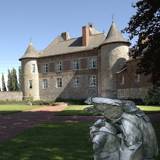
Towns and sites to discover along the Napoleon trail in Wallonia
The Napoleon trail in Wallonia lets you discover historic towns, architectural and cultural heritage and an icredibly diverse landscape.
It also gives you an opportunity to stop and admire, for a day or two, three UNESCO-listed sites.
Hestrud: Napoleon's path into WalloniaIt was in this little village on the border between Belgium and France, that Napoleon crossed over a tiny bridge into Belgium, and had an extraordinary encounter, which has been become a famous local legend.
A small stela, on the banks of the river, commemorates this extraordinary encounter which took place on 14 June, as Napoleon stopped to let his horse drink. The Emperor, who loved to be recognised, hailed a young village boy, called Cyprien-Joseph Charlet, ask asked him what he knew of him.
Confidently, the young boy told Napoleon that he knew exactly who he was and added |
|||||||||
Beaumont: A bivouac at the feet of La Tour SalamandreA gateway to Belgium for many invading armies, Beaumont is still home to the vestiges of numerous medieval fortifications. Napoleon and his troops set up their first bivouac there on 14 June 1815.
It was at the base of this tower that a section of the French troops set up their bivouac on 14 June 1815. Napoleon, for his part, spent the night on the grand place, in the town house of Maurice Gabriel Joseph Riquet de Caraman, prince of Chimay and, for the anecdote, made Baron of the Empire in 1813. Staying in a room on the first floor, the only one with a balcony, Napoleon Bonaparte entertained a certain madam Leporcq, the manageress of a roadhouse, to get as much information as possible on the state of the roads leading to Charleroi. There is a plaque emblazoned with the Imperial eagle evoking this visit, on the front of the house, which now houses a secondary school.
|
|||||||||
The Eau d’Heure lakes: the Walloon coast16 kilometres southeast of Beaumont, the five lakes that are artificially filled with water from the Eau d’Heure are both Belgium's largest group of artificial lakes and it's largest water sports centre.
The Barrage de la Plate Taille has a visitors' centre letting you better understand the workings of this impressive technical feat and discover the various advantages that this site has to offer tourists.
|
|||||||||
Château du Fosteau: General Reille's headquartersIt was in this solid 14th century structure that General Reille, commander of the 2nd corps of Napoleon's army, would set up his headquarters, on 15 June 1815. Several small museums are now housed within its walls.
You get access to the French gardens, to the original living pharmacy museum and to the room where General Reille, commander of the 2nd corps of Napoleon's army spent the night of 15 June 1815.
|
|||||||||
Biercée: The distillery produces Mandarine NapoléonSet in a majestic square farm, the Biercée distillery produces numerous eaux-de-vie, including the famous Mandarine Napoléon (Napoleon Mandarin).
Its setting is the Ferme de la Cour, a splendid square construction, superbly restored and still containing its original dungeon-tower, that dates back to the 14th century. It is a vestige of the old medieval courts of justice of the abbey of Lobbes, which defined the rules of judgement and the condemning of crimes.
Biercée distillery produces the famous It was a Belgian chemist who, after numerous attemps, would succeed at the end of the 19th century in creating a recipe that would be commercialised from 1882 by the Fourcroy family. Exported in more than 100 countries accross the world, Mandarine Napoléon is the 15th most sold liquor on the planet.
|
|||||||||
Thuin: Two jewels of UNESCO heritageOne of the oldest towns of the region, Thuin is special thanks to its two jewels of UNESCO heritage: the belfry and the folkloric march of Entre-Sambre-et-Meuse. 16 kilometres from Beaumont, just off the route taken by Napoleon, the town of Thuin is well worth the detour. It is lucky enough to have 2 jewels on the UNESCO heritage list: its belfry, 60m tall and dating back to the 17th century and the Saint-Roch march, a religious and folkloric procession. But Thudinie, is also a region of abbeys and castles, of museums dedicated to boating and tramways, stunning scenery, including that which overlooks genuine hanging gardens. Even if Napoleon never set foot there, Thuin was, on the morning of 15 June 1815, the site of severeal confrontations between French and Prussian troops.
|
|||||||||
Jamioulx: Napoleon's promiseThe beautiful village of Jamioulx was crossed, on 15 June 1815, by Napoleon's troops. The French Emperor even promised the village priest that he would make him a bishop!
It is within these walls that rests Jean-Nicolas Jénicot who, at the time of Napoleon's passage, was the village's priest. Having recognised him as he lead his horse to drink, he approached Napoleon and offered the Emperor a glass of his favourite wine, Chambertin. Striking up a conversation with him, his intelligence impressed the Emperor so much that, before he left him, Napoleon asked that the priest write his name in his notebook, adding that he would make the man the future bishop of Tournai.
Defeat at Waterloo, of course, prevented the realisation of this promise. |
|||||||||
Charleroi: Napoleon and the creation of the coal minesA site championed by UNESCO and a living memorial to one of the largest ever mining tragedies, the Bois du Cazier in Charleroi pieces together the world of mining in its golden age. The development of these mines was helped by an Imperial decree.
On 15 June 1815, the entirety of Napoleon's army that needed to cross the Sambre. The manoeuvre, initially well thought through, would eventuelly take over a day to be completed. To overlook proceedings, Napoleon set up camp in the cabaret de la Belle-Vue, by the ruins of the old ramparts. He was described as pensive, apathetic, to such a point that the cabaret was since given the nickname of Napoleon would then set up his headquarters at château Puissant (which no longer exists), where, only a few hours earlier, Prussian General Zieten had been staying! He would also learn that, only a few metres away, lived an old dragoon of the Great Army, called Joseph Thévernier. Needing a guide, the Emperor called for him to be brought to him, so he could obtain topographical information. It was accompanied by this faithful, retired Old Guard that Napoleon set off at dawn, towards Fleurus... for his final victory. |
|||||||||
The coal minesNothing much remains of the Charleroi that Napoleon once crossed. The city was transformed by the Industrial Revolution which made it, from the end of the 19th to the middle of the 20th century, one of Belgium's economic heartlands. Napoleon was no stranger to this, having made an Imperial decree on 21 April 1810 which organised the management of land to facilitate large-scale coal exploitation, like in Charleroi. In fact, the city has preserved some of the vestiges of this rich industrial past, including the Bois du Cazier, in Marcinelle, which is a listed UNESCO Heritage site. It offers, alongside a museum dedicated to to glass and one dedicated to industry, a poignant account of the work of miners, but also on one of the largest mining catastrophes of all time which took place on 8 August 1956, and saw 262 miners lose their lives.
A few kilometres from the Bois du Cazier, in an old convent in the heart of Mont-sur-Marchienne, the CHARLEROI PHOTOGRAPHY MUSEUM houses one of the largest photography collections in Europe. It also regularly holds major temporary exhibitions.
|
|||||||||
Fleurus: the site of three french victoriesLocated between Namur and Charleroi, Fleurus was the setting for three large battles. All three were French victories!
The locality, situated 14 kilometres north-east of Charleroi, is still home to various buildings that witnessed the latter battle, such as the Moulin Naveau mill, where Napoleon set up camp to study the local topography, Château de Zualart, which was his headquarters, Saint-Victor church, which was used as a hospital and Château de la Paix, where he spent the night. Now the town hall, this building will feature a reconstruction of Napoleon's bedroom in 2015.
Would you like to know more? |
|||||||||
Ligny: Napoleon's last victoryThe town of Ligny figures on all of the monuments associated with the great moments of the Napoleonic era. It has pride of place on the Arc de Triomphe in Paris and in Ajaccio, for example. The little village in the Province of Namur was the setting, on 16 June 1815, of's Napoleon's last victory.
The battle of Ligny/Fleurus is, it's true, far from being anecdotal. The strength of the forces that day was, for example, similar to that of those present at the battle of Austerlitz. A conflict between a portion of Napoleon's troops and those of Prussian Blücher, it was characterised by obstinacy and tenacity from both sides, to the point of exhaustion. This goes a long way to explain the number of casualties, but also the fact that we can put into perspective the scale and importance of the victory. For, although it was indeed a French victory, it was not a complete victory. The Prussian army, which had suffered greatly at the hands of the French through the centre of their force and lost some 20,000 men, was able to save its flanks and fall back towards Wavre rather than towards Namur, which would have definitively cut it off from the frontline of combat. This action by the Prussians would considerably change the course of the Campaign in Belgium, as Napoleon was forced to send field marshal Grouchy's, corps of 30,000 men, to pursue them.
This Napoleon themed museum recalls Napoleon's final victory, before the famous battle of Waterloo, in an authentic 18th century setting.... |
|||||||||
Villers-la-Ville abbey: the most beautiful Cistercian ruins in Europe!On the edge of the Napoleon trail in Wallonia, the ruins of Villers-la-Ville's Cistercian abbey form a enchanting setting which has impressed some of the great romantic authors, including Victor Hugo.
It is undoubtedly one of the most beautiful Cistercian sites in Europe, which served as inspiration to many a romantic author, including Victor Hugo, who used the setting to describe some of the decors in In summer, it welcomes theatrical, musical and historical shows in a magical atmosphere. A bucolic garden of medicinal plants allows you to better understand the history of pharmaceuticals. All manner of guided tours are available and throroughly recommended.
Would you like to know more? The Tourist Office for the Villers Region in Walloon Brabant invites you to discover its land which is rich in rural and historic heritage.... In the Walloon Brabant province, the Cistercian abbey of Villers unveils 850 years of history and numerous events and activities all year round.... |
|||||||||
The Quatre-Bras de Baisy-Thy: The first Franco-British confrontationA few kilometres from Ligny, the Quatre-Bras crossroads in Baisy-Thy was the setting for the first Franco-British battle of the campaign in Belgium. A prelude to what would happen in Waterloo.
The battlefield has never even been officially recognised and only a few, sparse monuments mark the event, such as the impressive column erected in 1890 in honour of the Duke of Brunswick, who fell while attempting to quell the wave of panic that came over the young troops.
|
|||||||||
Nivelles: birthplace of the Carolingians12 kilometres from the Quatre-Bras, Nivelles is the proud home of an Ottonian and Mosan collegiate church, which is a reminder that the town was, in the 7th century, one of the birthplaces of the Carolingian dynasty.
Sorely tested by the bombings of the Second World War, the town, still watched over by its jacquemart of Jean de Nivelles still retains numerous vestiges of the great moments of its history. It also plays host to a great many folkloric events, and gastronomic events which are anchored in and integral to the lives of its inhabitants and give it a very special character and soul.
Only 25 km from Brussels, the Roman Païs region contains the towns of Braine-le-Château, Ittre, Nivelles, Rebecq and Tubize and is known for its diversity and charm.... |
|||||||||
Le Caillou in Vieux-Genappe: Napoleon's last headquartersIt was in the Ferme du Caillou, north of the town of Genappe, that Napoleon would, on the night of 17 to 18 June 1815, set up his last headquarters.
The farm was in turmoil throughout the night. Although the site was burnt down on the eve of the battle, it has now been converted into an interesting museum in honour of Napoleon. Exhibits include Napoleon's authentic camp beds, his death mask, a lock of hair and personal objects, as well as many relics discovered on the battlefield. An ossuary in the grounds houses the bones that are constantly being unearthed on the battlefield. Among which, those of the 10,000 or so horses that also perished during the fighting.
|
|||||||||
Braine-l'Alleud: The Lion's Mound dominates the battlefieldStretching over the towns of Braine-l’Alleud, Genappe, Lasne and Waterloo, the Waterloo Battlefield covers an area of just over 6200 acres of fields, hills and dales, as described by Victor Hugo. The battlefield lies under a monumental mound, topped by an equally monumental iron lion, symbolizing Holland's participation in the Anglo-Prussian victory.
Waterloo battlefield The battlefield stretches over a little more than 6200 acres of fields, hills and dales, to quote the words of Victor Hugo. On 18 June 1815 it would witness the confrontation of almost 300,000 men, from all over Europe, determined to put an end to over 20 years of war. Protected by a preservation law unique of its kind, there still remain some impressive vestiges of the battle that put a definitive end to the absolute rule of Napoleon Bonaparte. From the moment the battle ended, the battlefield became a major remembrance tourism venue. It was here that the concept of tour operators was born, with coaches bringing more and more visitors from London, Ostend, Ghent and Brussels. Numerous legends were born here. It was very popular with romantic authors such as Victor Hugo, Walter Scott, Lord Byron, Alexandre Dumas, Stendhal and Thackeray having spent time there.
The Lion's Hamlet On the northern crest of the battlefield lies the Lion's hamlet, straddling the two municipalities of Braine-l’Alleud and Waterloo, which has become a major historical, cultural and tourist attraction in Wallonia. With the bicentenary of the battle of Waterloo approaching, it has been subject to some major renovation works aimed at improving the site.
At the foot of the famous Lion's Mound - the imposing monument which was erected in 1826 on the spot where the Prince of Orange was injured in Braine-l'Alleud - an underground In the shadow of the Lion's Mound, the Panorama of the battle of Waterloo has also been restored. This ancestor of the cinema, protected by UNESCO, projects several of the battle scenes on a 110m long and 12m high canvas. Several historic farms in the vicinity, such as Mont-Saint-Jean and Hougoumont, are also undergoing refurbishment and scenographic work. They will be welcoming a reconstruction of the Empire's largest bivouac from 18 to 21 June 2015 – a first in Europe – featuring around 5000 re-enactors.
|
|||||||||
Waterloo: The Wellington Museum and more than a hundred Waterloos around the worldIt was in an inn, at the heart of the town of Waterloo, that Wellington set u up his headquarters from 17 to 19 June 1815. It was thanks to, or because of this choice of location, that the battle would forever be known as the battle of Waterloo. Much like for the 124 other places all over the world bearing the same name.
Even Napoleon, from 1815, ended up referring to the battles of 18 June 1815 as "Waterloo", giving the then small village on the edge of the Sonian forest, a universal image. This vast construction, built in 1705, is now home to a remarkable museum evoking, belligerant by belligerant, the various phases of the battle, but also its repercussions on the history of Europe and even the world. An entire room is dedicated to the 124 other Waterloos spread throughout the world, mostly created by demobilised British veterans who were offered plots of land in the colonies and hastened to christen them with the name of their last and most glorious battle. This is why you will find Waterloos in Australia, New-Zealand, the United Kingdom, Germany, Ukraine, Sierra Leone, South Africa, the USA, Canada, Trinidad and Tobago, Antarctica and even a little corner of Brittany in France. Set opposite the museum is the Royal Chapel of Waterloo, built in 1687 in honour of Charles II of Spain in the hope that it would help him sire a male heir to his throne. But it was not to be. On the day after the battle, the chapel was converted into a temple honouring Wellington and his allies. The walls of the adjacent church are adorned with numerous funeral plaques of officers and soldiers killed in combat.
|
|||||||||